Capital Region Degree Awards Grow at Fastest Pace in Four Years

Siena University saw a 21.5 percent increase in degree awards in 2025. Courtesy Siena University.
- Degree awards increased 2.7% in 2025
- Fastest degree-award growth rate in four years
- STEM degree awards increased 2.9%
- Siena University degree awards increased 21.5%
- UAlbany degree awards increased 10.8%
- Russell Sage College degree awards increased 9.2%
- Belanger School of Nursing degree awards increased 49%, producing the largest graduating class in the school’s history
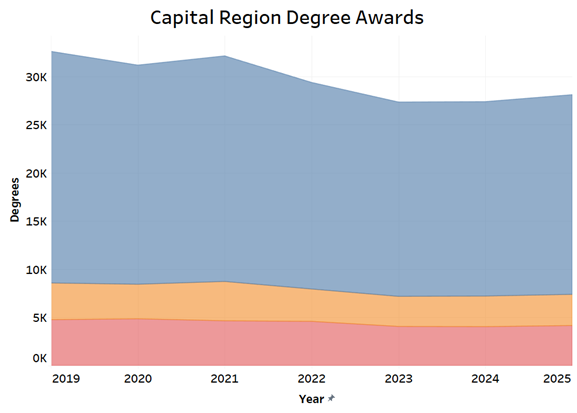
The Capital Region’s higher education institutions increased degree production in 2025 at the fastest rate in four years, demonstrating the resilience of the region’s talent pipeline following significant changes in its higher education landscape. According to a Center for Economic Growth (CEG) analysis of data from the National Center for Education Statistics’ Integrated Postsecondary Education Data System (IPEDS), degree awards increased over the year by 2.7 percent, providing an encouraging sign for employers seeking skilled talent.
“By remaining agile and responsive to an ever-changing professional landscape, Siena University is honored to play an ongoing role in fueling our local and regional workforce in a wide range of fields with highly prepared graduates who are ready to serve, innovate and lead. We continue to proactively meet workforce needs, launching new and relevant academic majors such as business analytics, digital marketing, physics/engineering, and cybersecurity, and expanding existing majors such as education, communications and nursing, as well as our MBA and graduate certificates such as business transformation with artificial intelligence. Our programs are aligned with modern industry needs to fuel our economy with career-ready leaders,” said Siena University President Chuck Seifert.
Degree Awards
In 2025, 22 colleges and universities in the eight-county Capital Region awarded 20,709 degrees, up 2.7 percent from the previous year. Among the region’s 20 traditional colleges and universities, degree awards increased 1.8 percent to 13,664. Degree awards at the region’s two distance-learning institutions – Empire State University and Excelsior University – rose 4.5 percent to 7,045.
For employers across the region, the growth signals that local institutions continue to produce the talent needed to support business expansion and economic growth.
Particularly encouraging was growth in STEM-related fields. Degree awards in science, technology, engineering, and mathematics disciplines increased 2.9 percent to 4,165, expanding the talent pipeline for the Capital Region’s advanced manufacturing, semiconductor, engineering, life sciences, and technology sectors. Health-related degree awards increased 1.7 percent to 3,231.

University at Albany 2026 Graduate Commencement Ceremony. UAlbany degree awards were up 10.8 percent. Courtesy UAlbany.
Higher Education Partnerships Help Retain Talent
The Capital Region’s colleges and universities demonstrated remarkable adaptability following the 2024 closure of The College of Saint Rose.
Through teach-out agreements, transfer pathways, and expanded academic offerings, regional institutions helped many Saint Rose students continue their education and complete their degrees within the Capital Region. These efforts contributed to strong growth in degree awards at several institutions in 2025, including Siena University (21.5 percent), UAlbany (10.8 percent), and Russell Sage College (9.2 percent).
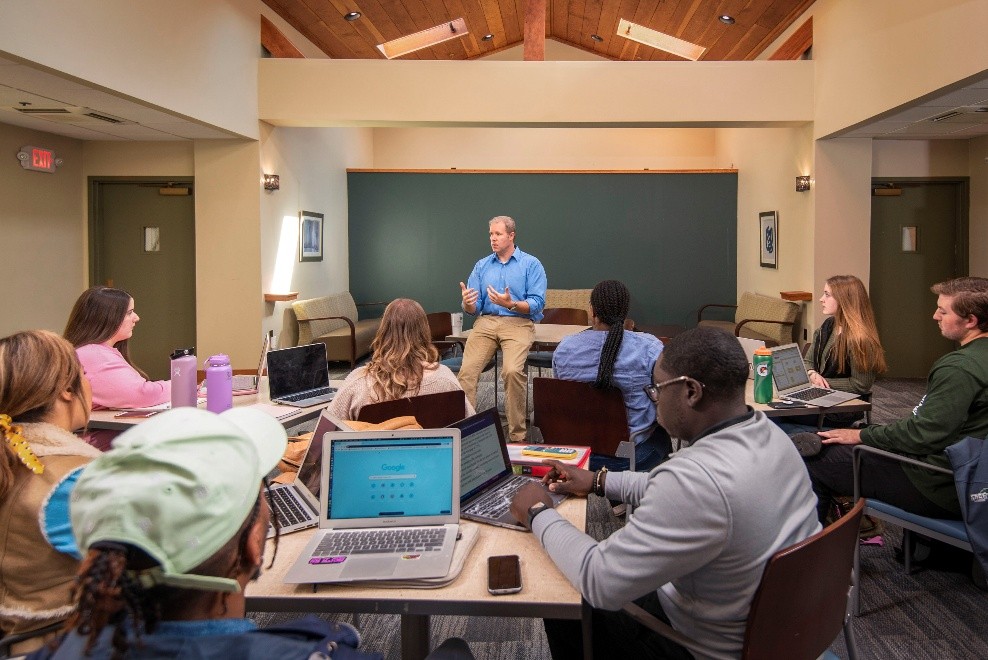
Russell Sage College had a 9.2 percent increase in degree awards. Courtesy Russell Sage College.
Prior to its closure, Saint Rose entered into teach-out agreements with Siena University, Russell Sage College, UAlbany, and Albany College of Pharmacy and Health Sciences. UAlbany also launched new undergraduate teacher certification programs and assumed responsibility for maintaining Saint Rose student academic records, helping preserve educational pathways in a field facing workforce shortages.
Meanwhile, Siena University also expanded its academic offerings after Clarkson University transferred 16 teacher education programs from its Capital Region Campus. Together, these transitions strengthened opportunities for students to remain in the region, complete their degrees, and enter the local workforce.
Rather than diminishing the Capital Region’s talent pipeline, the coordinated response by local colleges and universities helped retain students, support degree completion, and sustain the flow of graduates into the regional economy.
Nursing Pipeline Sees Significant Growth
Healthcare workforce development also recorded a notable gain in 2025.
Ellis Medicine’s Belanger School of Nursing increased degree awards by 49 percent to 73 graduates, the largest graduating class in the school’s history. The increase followed a collaboration between Ellis Medicine and SUNY Schenectady that created expanded educational pathways from the community college into nursing careers.
The growth is particularly significant given the continued demand for healthcare professionals throughout the Capital Region and New York State.
Hudson Valley Community College also reported a 9.3 percent increase in degree awards, supported by gains in business administration, management, and health diagnostics programs.
NOTES
Award totals include first and second degrees.
1 2024 data for the College of Saint Rose was not reported in IPEDS for 2024. The institution’s 2024 degree total is based on reports that 668 students walked at the college’s final graduation ceremony that year, down 15.2 percent from the total awards reported by IPEDS for 2023. For Saint Rose’s 2024 STEM and Health Professions and Related Programs degree totals, that year-over-year rate of change was applied to these fields’ 2023 totals reported by IPEDS.
2 STEM fields include 1. Computer and Information Sciences and Support Services; 2. Engineering; 3. Engineering Technologies and Engineering-related Fields; 4. Biological and Biomedical Sciences; 5. Mathematics and Statistics; 6. Physical Sciences; 7. Science Technologies/Technicians; and 8. Mechanic and Repair Technologies/Technicians.
CEG Initiatives
As a group sponsor for several apprenticeship programs in the Capital Region, CEG helps manufacturers upskill their workforce by leveraging community college partners, such as HVCC, and online education tools available via Tooling U. CEG currently supports 64 active apprentices at eight Capital Region manufacturers for the following trades: Industrial Manufacturing Technician, Nanotechnology Engineering Technician and CNC machinist. Participating manufacturers include GlobalFoundries, NY CREATES, Energy Catalyst, Ross Precision Machining, Meridian Manufacturing, Greno Industries, Jenks Machine and Tool Co., and Trelleborg Sealing Solutions.
Don’t miss these insights into the trends that are shaping the Capital Region’s economy. Sign up for CEG’s e-news and follow us on: