Albany Region Among Nation’s Leaders in Shift Away from Remote Work

Dave Duggal’s Glens Falls software company, EnterpriseWeb, is a virtual firm with no physical offices and a remote workforce.
Highlights
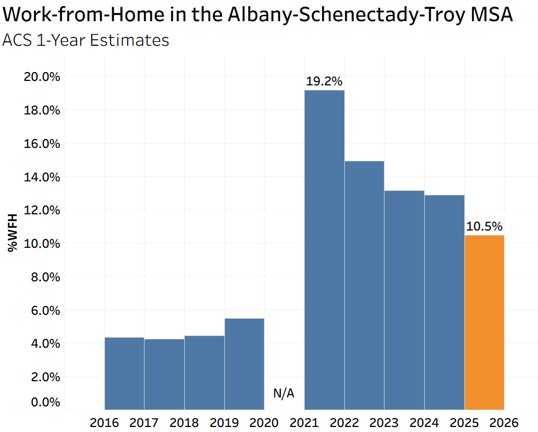
- 10.5% of the Albany-Schenectady-Troy MSA’s workforce worked from home in 2025.
- The metro’s 2025 WFH rate marked its fastest decline since 2022.
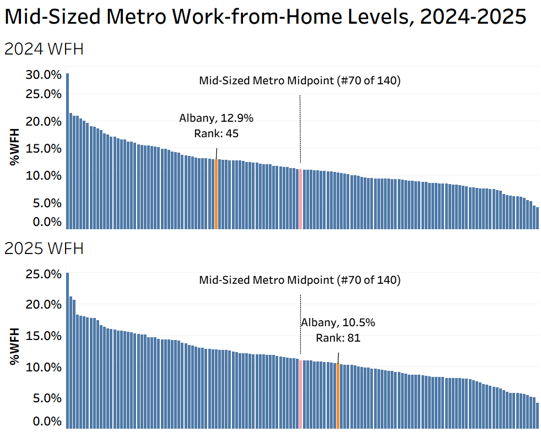
- The Albany metro went from the 45th highest mid-sized metro WFH rate in 2024 to the 81st last year.
- Data points to more WFH in the Glens Falls MSA, which was boosted by Warren County.
The ranks of people working from home in the Albany-Schenectady-Troy metropolitan statistical area last year declined at their fastest rate since pandemic restrictions loosened in 2022. That puts the area ahead of more than half of the nation’s mid-sized metros when it comes to shifting to back-to-office from work-from-home, according to a Center for Economic Growth (CEG) analysis of new one-year estimates from the U.S. Census Bureau’s American Community Survey.
Albany-Schenectady-Troy MSA WFH
In 2025, an estimated 48,117 workers worked from home in the five-county Albany-Schenectady-Troy MSA. That accounted for 10.5 percent of the area’s workforce. It was down from 12.9 percent the previous year. That 2.4 percentage-point annual decline was the biggest since 2022, when the rate decreased by 4.3 percentage points from the 2021 pandemic peak of 19.2 percent.
While the statistics do not cover hybrid work arrangements1, the metro area’s shift away from WFH bodes well for efforts to revitalize downtowns, especially the $400 million Championing Albany’s Potential (CAP) Initiative.
The Albany-Schenectady-Troy MSA’s 2.4-percentage-point decline in its WFH rate was the 16th biggest among the 140 U.S. mid-sized metros with populations between 250,000 and 999,999. The Albany-Schenectady-Troy MSA went from having the 45th highest mid-sized metro WFH rate in 2024 to the 81st highest in 2025. Despite seeing a 3.7-percentage point decline in its WFH rate in 2025, the Boulder MSA retained its position as having the largest mid-sized metro share of WFH workers, at 24.9 percent.
Glens Falls MSA WFH
Bucking the shrinking WFH trend was the Glens Falls MSA, which consists of the Capital Region’s two northernmost counties: Warren and Washington. That metro’s 2025 WFH rate was 10.4 percent, which was above the previous year’s rate of 7.7 percent but more in line with 2023’s rate of 10.0 percent.2 Warren County drove the metro’s WFH growth. Its WFH rate rose to 13.5 percent last year, which was above the pandemic peak of 11.3 percent.3
Notes
1 The ACS work-from-home worker counts focus primarily on “those who work from home for the majority of the workweek.” The Census Bureau notes this focus “likely excludes those who work from home less frequently or less routinely,” as is the case with hybrid work arrangements.
2 ACS estimates for small metros with populations below 250,000 are more prone to fluctuation due to their sample size.
3 Warren County’s population is just above the Census Bureau’s population threshold for ACS 1-year estimate reporting, also making its data prone to fluctuation.
CEG Initiatives
As a regional economic development organization, CEG has worked to create a more integrated and dynamic eight-county Capital Region by leading industry and attraction efforts centered around the Capital Region’s core technology clusters. Many employers in these clusters leverage work-from-home or hybrid work arrangements, especially in digital gaming and tech R&D.
Don’t miss these insights into the trends that are shaping the Capital Region’s economy. Sign up for CEG’s e-news and follow us on: