250 Years of Shipbuilding Legacy in Washington County
Washington County MFGs continue work that Benedict Arnold spearheaded
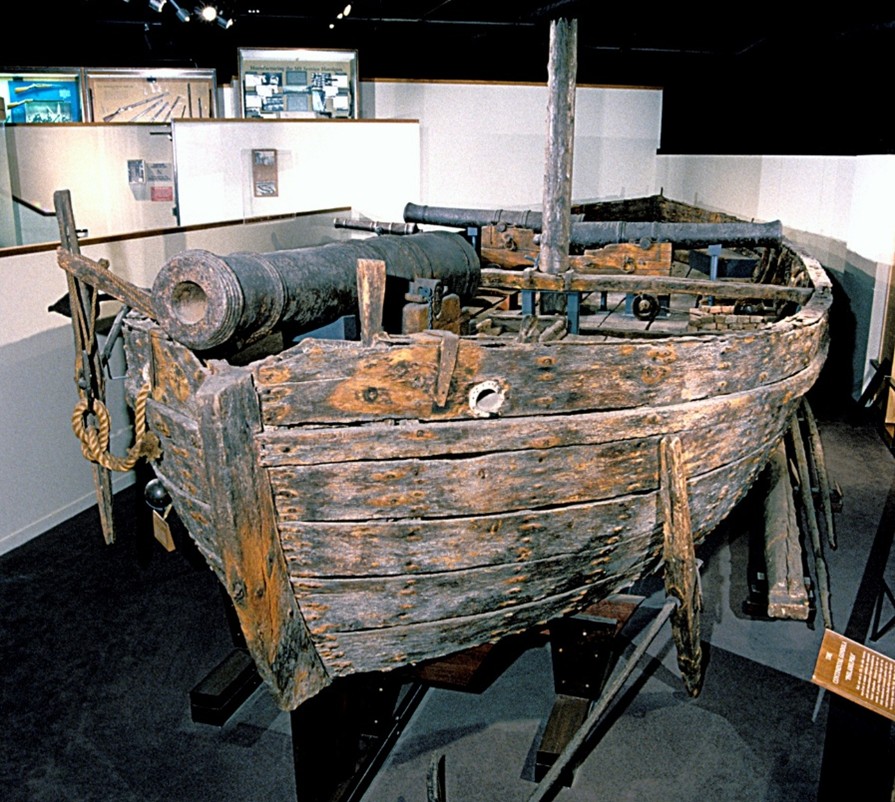
Photo credit: The gunboat Philadelphia was constructed at the Skenesborough shipyard and was launched on September 3, 1776. Courtesy Smithsonian.
Highlights
- This spring marks the 250th anniversary of the Continental Army’s development of a shipyard in Whitehall and construction of the first U.S. inland fighting fleet.
- Washington County manufacturers continue the naval manufacturing tradition that started with Benedict Arnold’s Navy.
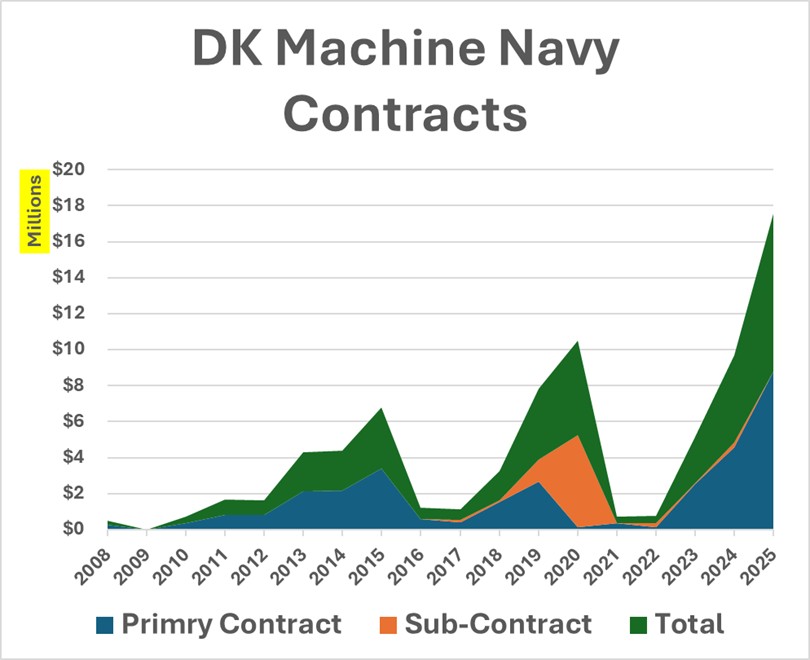
- DK Machine saw an 81% increase in U.S. Navy contracts in FY2025.
- The Fort Miller Group supplied pre-cast concrete Portsmouth Naval Station expansion.
- Washington County to celebrate Whitehall Naval Heritage Weekend in October.
A few weeks before the signing of the Declaration of Independence, work began on the Continental Army’s first inland fighting fleet on Lake Champlain’s southern shore in Whitehall, New York. And 250 years later, several Washington County companies are continuing that naval-related manufacturing tradition that was initially spearheaded by Benedict Arnold.
A Rural Shipbuilding Tradition
As the U.S. Navy reprioritizes domestic shipbuilding capacity, the increased demand for submarines and surface vessels is having an impact on manufacturers in Washington County. For example, ball valve maker DK Machine in Fort Edward experienced an 81 percent annual increase in U.S. Navy contracts in fiscal year 2025.
It was in spring 1776 when preparations began in Whitehall – then known as Skenesborough – for the construction of the Continental Army’s fleet at a makeshift shipyard. Plans for the Skenesborough shipyard originated with General Philip Schuyler, who commanded the Continental Army’s Northern Department. However, the fleet built there is referred to as “Benedict Arnold’s Navy,” because of the brigadier general’s role overseeing the vessels’ construction as well as his command over them during the Battle of Valcour Island on October 11, 1776. That was the first major naval battle after the colonies declared their independence on July 4, 1776.
“As the nation marks this 250th anniversary, Washington County, New York stands apart for building America’s first naval fleet – a legacy that lives on through a modern manufacturing sector still supporting the Navy today,” said Washington County Director of Economic Development Laura Oswald. “From the first oak gunboats constructed in Whitehall in 1776 for what would become the US Navy to modern materials and technology such as concrete and machine tools integral to modern Naval ships ingenuity, skill, and the spirit of craftsmanship epitomize 250 years of manufacturing in Washington County.”
Shipbuilding Infrastructure
Skenesborough was founded by a British Army officer, Philip Skene. In May 1775, shortly after capturing Fort Ticonderoga, colonial militiamen also seized Skene’s estate, which included grist mills, saw mills, an iron foundry, and a shipyard, as Captain Elisha Phelps reported to the Connecticut General Assembly on May 16, 1775. A year later, by May 31, 1776, Schuyler had sent carpenters from Lake George to Skenesborough. On June 7, he issued orders to Assistant Commissary General Hermanus Schuler to go to Skenesborough and “take Charge of the Carpenters, Ax-men, Teamsters & Blacksmiths at that place and do every Thing in your power to forward the Building of the Gundaloes.” On June 17, the Continental Congress noted that Philip Schuyler ordered a lock to be built at Skenesborough ,“so as to have a continued navigation for batteaus from Cheshire’s into Lake Champlain.”
Washington County manufacturers continue to support naval infrastructure construction efforts. For example, in 2020 the Fort Miller Group in Greenwich was subcontracted by Cianbro under a Navy contract for a superflood basin project at the Portsmouth Naval Shipyard. The Pittsfield, Maine-based Cianbro subcontracted with Fort Miller for pre-cast concrete tunnel and pile caps. The Kittery, Maine shipyard’s superflood basin official opened in 2022.
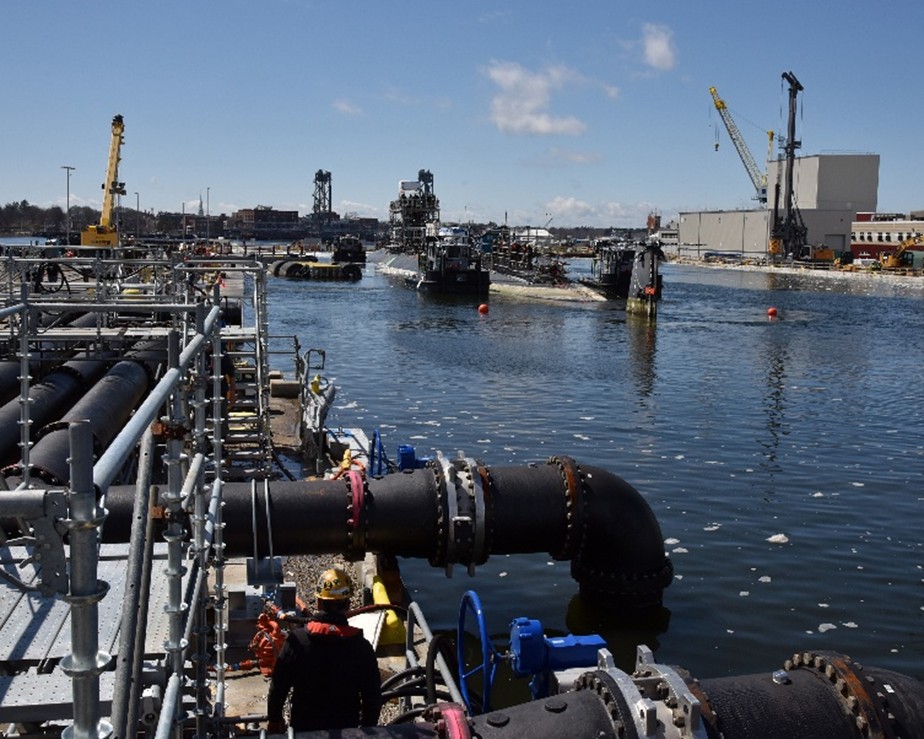
The Fort Miller Group in Greenwich, New York supplied pre-cast concrete for a new super flood basin at the Portsmouth Naval Station in Kittery, Maine. US Navy photo by Jim Cleveland.
Naval Supplies
An abundance of supplies around Whitehall, namely timber, was critical to the shipbuilding effort. On August 7, Arnold reported three galleys would be launched within two weeks and timber was cut for three or four more. “The carpenters are very industrious and spirited. Nothing will retard the building but want of plank and iron,” Arnold said. On September 3, General David Waterbury reported plans to send to Ticonderoga the gunboat Philadelphia, which is now at the Smithsonian.
Continuing this tradition of supplying critical parts is DK Machine, a valve ball manufacturer in Fort Edward, about 23 miles south of Whitehall. In fiscal year 2025, DK Machine was awarded $8.8 million in Navy contracts – the most they’ve received in more than 17 years, according to data from USASpending.gov.
Naval Tools
When Philip Schuyler in late May sent the first company of carpenters to Skenesborough to build gondolas, he noted “Nothing is prepared for building them – I hope nevertheless to finish one in a short Time.” He also requested hand jacks (lifting devices), a grind stone and a black smith from Ticonderoga. On June 12, Philip Schuyler told General George Washington, “I fear the Saw mills will Not be able to saw a sufficient Number of Plank, I wish to have a Dozen of Whip Saws & Files sent up with all possible Dispatch.”
Washington County manufacturers continue to supply tools for the Navy’s shipbuilding industry. For example, in 2023, Cambridge Valley Machining in Cambridge was subcontracted by provided L3 Technologies to provide special die tools and fixtures under a Navy contract. That contract pertained to the OE-538B Antenna System, which is a single-service, submarine-unique, mast-mounted, multi-function antenna system.
Shipbuilding Workforce
The Continental Congress, on June 3, 1776, voted to authorize its Maritime Committee “to contract with shipwrights, to go to Lake Champlain.” On June 16, 1776, even George Washington expressed shipbuilding workforce concerns, telling Philip Schuyler in a letter that shipwrights “cannot be now had, every one qualified for Business, being employed here [in New York].”
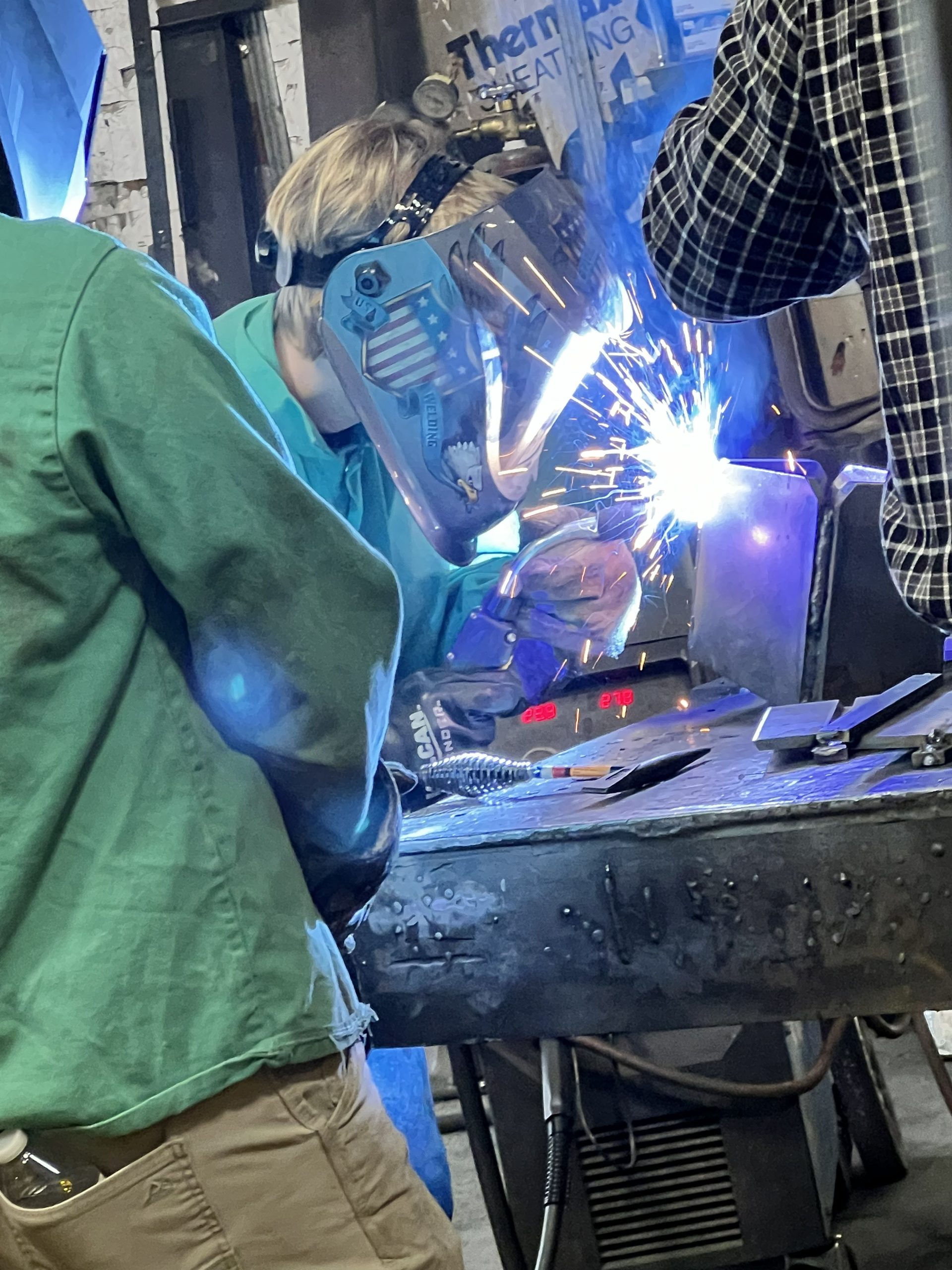
A student practices welding at the Southern Adirondack Education Center in Hudson Falls. Courtesy WSWHE BOCES
Washington County continues to train workers who support naval-related manufacturing through Welding and Industrial & Performance Machining programs at the Southern Adirondack Education Center in Hudson Falls. Local employers designed the 500-hour machining program, in collaboration with the Saratoga-Warren-Washington Workforce Development Board and WSWHE BOCES. The 30-hour welding program trains students on electric arc and other welding techniques, as well as SMAW (Stick) welding. The Southern Adirondack Education Center also offers a 145-hour Marine Technology Program.
Whitehall Naval Heritage Weekend
On Oct. 2-3, 2026, Washington County will host a Whitehall Naval Heritage Weekend, which “honors the 250th anniversary of Benedict Arnold’s northern naval campaign.” Events include a Valcour Bay heritage tour, speaker series with local and nationally recognized authors and historians, and community gatherings.
During the Battle of Valcour Island, near Plattsburgh, Arnold lost 11 ships, many of which had been constructed at Skenesborough. His fleet also suffered 200 casualties at the hands of the larger British fleet with approximately 25 combat ships/vessels. However, Arnold’s Washington County-made fleet succeeded in delaying the British advance down Lake Champlain and its assault on Fort Ticonderoga.
According to the Whitehall Chamber of Commerce, the New York State Legislature in 1960 passed a resolution naming Whitehall the Birthplace of the United States Navy. In the 1950s, 1960s and 1970s, several resolutions were introduced in Congress proposing to recognize the Village of Whitehall as the “birthplace of the US Navy.” However, four other towns also claim to be the Navy’s birthplace. Last year, the Navy celebrated the 250th anniversary of when the Second Continental Congress in 1775 requested a “fleet of sufficient force for the protection of these colonies.” At events recognizing that anniversary, both Secretary of the Navy Carlos Del Toro and Chief of Naval Operations Admiral Daryl Caudle identified Philadelphia as the Navy’s birthplace.
Part of the debate over the birthplace claim stems from the fact that the Whitehall shipyard was an initiative for the Continental Army, rather than the Continental Navy. The ships also sailed inland lakes, rather than the high seas. Either way, Whitehall is undisputably where Continental forces during the Revolutionary War built their first major lake fleet.
Capital Region Shipbuilding Supply Chain
The Capital Region is a major driver of Navy combat vessels. The region is home to two of the Naval Nuclear Laboratory’s five primary locations. Knolls Atomic Power Laboratory in Niskayuna, which led the design of the reactor plant for the Columbia- and Virgina-class submarines as well as the Kenneth Kesselring Site in West Milton, which trains nuclear officers and enlisted personnel to operate Navy submarines.
Several local manufacturers provide parts and supplies to the Navy and its industrial base. They include Espey Mfg & Electronics in Saratoga Springs; Burnham Polymeric in South Glens Falls, Barton in Glens Falls; Greno Industries in Scotia; Albany Valve & Fitting Co. in Albany; and P1 Industries in Schenectady. Menlo Micro, which has R&D operations in Albany, is testing its high-power switch technology under the Navy’s Advanced Circuit Breaker Program. And in nearby Schoharie, Harva has provided a small plastic part for every nuclear submarine built in the U.S.
CEG INITIAIVES
As a New York State MEP center, CEG’s Manufacturing Solutions helps Capital Region defense contractors and other manufacturers increase their productivity by providing a menu of technical support services, such as Lean Enterprise Training, ISO Certification Assistance, Technology-Driven Market Intelligence, and CoreValue benchmarking assessments.
CEG is the sponsor of several Registered Apprenticeship Programs for the following manufacturing trades: industrial maintenance technician, nanotechnology engineering technician, CNC machinist, and welder. Participating manufacturers include GlobalFoundries, NY CREATES, Plug Power, Ross Precision Machining, Meridian Manufacturing, Greno Industries, Jenks Manufacturing, and Espey Mfg, and Electronics.
CEG also drives the Manufacturing Solutions Network a network brings together Capital Region manufacturers to learn from experts on industry relevant topics, participate in thematic roundtables, discuss common issues, and expand their network.
Don’t miss these insights into the trends that are shaping the Capital Region’s economy. Sign up for CEG’s e-news and follow us on: